Introduction
Radiation is part of the natural environment, even when it cannot be seen, smelled, or felt. Small amounts of ionizing radiation can come from cosmic rays, naturally occurring radioactive materials in soil and rocks, certain building materials, and other environmental sources. Additional exposure may occur in specialized workplaces, scientific laboratories, medical settings, and situations involving radioactive materials.
A handheld radiation detector can help make some of this otherwise invisible information measurable. By detecting radiation interactions and displaying readings, these instruments can support educational activities, environmental observations, and certain radiation-awareness tasks. However, understanding what a detector measures—and what its readings cannot establish—is just as important as understanding its features.
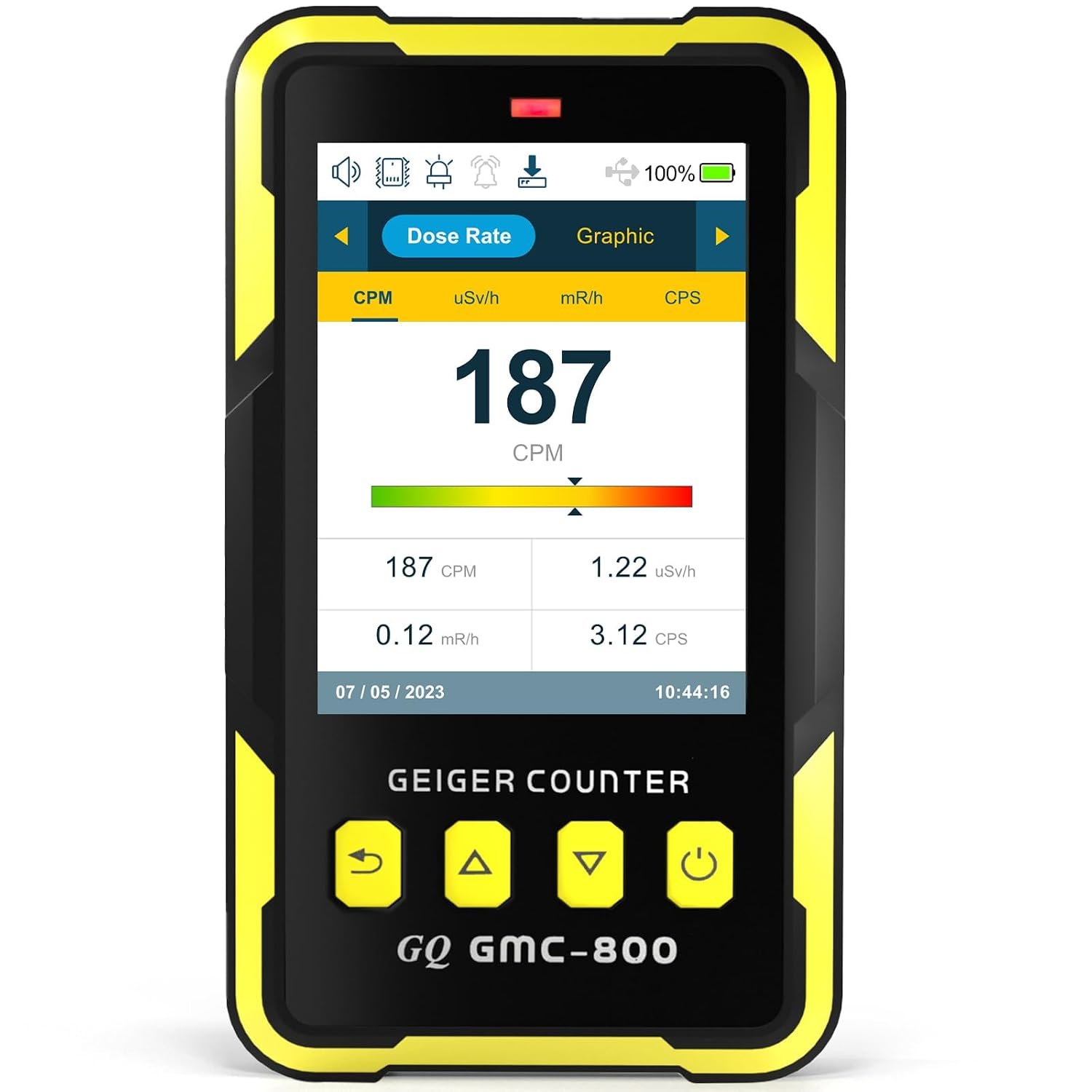
The GQ GMC-800 Geiger Counter is a portable radiation detection device advertised with a large color LCD, multiple alarm types, data-saving capabilities, and global data-sharing features. Its advertised detection scope includes beta, gamma, and X-ray radiation. The product is designed for users who want access to radiation readings in a compact, handheld format rather than relying exclusively on fixed monitoring equipment.
A device in this category may be useful for learning about background radiation, comparing readings between locations, or keeping records during non-emergency observations. It can also help users become more familiar with measurement concepts such as counts per minute, dose rate, and accumulated dose.
Nevertheless, a consumer Geiger counter is not automatically a substitute for professional radiation survey equipment. Measurement accuracy depends on the detector design, calibration, radiation type and energy, measurement conditions, and the way the instrument is used. An alarm or a single reading should not be treated as definitive proof that a location or object is safe or dangerous.
This guide explains the advertised features of the GQ GMC-800, common applications for handheld radiation detectors, important measurement concepts, and practical considerations before selecting a device for personal, educational, or professional use.
What Is the GQ GMC-800 Geiger Counter?
The GQ GMC-800 is a portable radiation detector sold under the GQ Electronics brand. It is described as a Geiger counter intended to detect certain forms of ionizing radiation and present measurement information through a color display.
Geiger counters commonly use a gas-filled detection tube or a related sensing arrangement to register interactions caused by ionizing radiation. When suitable radiation enters the sensitive detector, it can produce an electrical pulse. The instrument processes these pulses and presents information according to its design and configuration.
The GMC-800 is advertised for beta, gamma, and X-ray detection. These radiation categories are related, but they are not interchangeable. Beta radiation consists of energetic electrons or positrons, while gamma rays and X-rays are forms of electromagnetic radiation with different origins. The detector’s ability to register each type depends on its sensor, housing, energy response, and operating conditions.
The product listing also advertises a large color LCD, five alarm types, a dosimeter function, data storage, and global sharing features. These functions may help organize readings and make the information easier to review.
Before relying on any particular specification, prospective users should consult the current product listing and manufacturer’s documentation. Exact measurement ranges, supported units, memory capacity, battery requirements, calibration details, and software or sharing compatibility should be verified rather than inferred from the product title alone.
Key Features of the GQ GMC-800
1. Portable Radiation Detection
Portability is one of the defining characteristics of a handheld Geiger counter. Instead of being permanently installed in one place, a portable detector can be carried between observation points and used to collect readings under different conditions.
For educational purposes, portability makes it possible to compare measurements in a classroom, outdoors, or in other appropriate environments. A researcher or trained user may also find it convenient for preliminary surveys where a handheld instrument is suitable for the task.
The GQ GMC-800 is presented as a portable device. Its practical value depends on more than physical size, however. Battery life, screen readability, operating controls, environmental limits, and the need for additional accessories can all influence how convenient it is to use.
A portable detector should not automatically be considered suitable for every radiation survey. Some tasks require a specific detector type, calibrated instrumentation, contamination-monitoring equipment, or professional survey procedures.
2. Large Color LCD Display
The product is advertised with a large color LCD display. A screen can make radiation information easier to interpret by presenting numerical readings and instrument status in a visible format.
Depending on the available display modes and firmware, a detector may present information such as radiation count rate, dose rate, accumulated dose, alarm status, or measurement history. The exact information shown by the GMC-800 should be confirmed in its manual.
A color display can also help distinguish different categories of information, but visual clarity does not establish measurement accuracy. A precise-looking number may still have uncertainty associated with detector response, calibration, counting statistics, and environmental conditions.
Users should learn what each displayed value represents before interpreting it. For example, a count rate is not the same measurement as a dose rate, even though both may be displayed by radiation instruments.
3. Advertised Detection of Beta, Gamma, and X-Ray Radiation
The GMC-800 is marketed for detecting beta, gamma, and X-ray radiation. Understanding these categories helps explain why detector selection matters.
Beta radiation consists of energetic electrons or positrons emitted during certain radioactive decay processes. Its penetration depends on particle energy and the material between the source and detector. A device’s ability to detect beta radiation may be affected by the thickness of its housing or any protective window over the sensing element.
Gamma radiation consists of high-energy photons emitted by radioactive nuclei. Gamma rays can penetrate many materials more readily than beta particles, although their transmission depends on photon energy and the material’s composition and thickness.
X-rays are also high-energy photons, commonly generated through processes involving electrons. They can have energy ranges that overlap with gamma rays, and many detectors respond to both. Their practical measurement characteristics can still differ depending on energy and instrument design.
The phrase “detects radiation” should not be interpreted as “detects every radioactive material under every condition.” A detector may fail to register radiation that is too weak, poorly matched to its sensitivity, shielded by intervening material, or outside its effective energy response.
Alpha radiation is another important category. It is not listed among the GMC-800’s advertised detection types in the supplied product title. Prospective users who need alpha detection should verify the detector’s specifications and should not assume that the device can measure it adequately.
4. Multiple Alarm Types
The product title advertises five alarm types. Alarms can help draw attention to a reading or an instrument condition without requiring the user to watch the screen continuously.
Depending on the manufacturer’s implementation, alarms on radiation instruments may be associated with a configurable dose-rate threshold, accumulated dose, count rate, or another operating condition. The exact five alarm types advertised for the GMC-800 should be checked in its current manual rather than guessed from the product title.
Alarm settings are particularly important because a detector may be configured for different purposes. A threshold appropriate for one monitoring task may be unsuitable for another. An overly high threshold could delay notification, while an overly sensitive setting could generate frequent alerts during ordinary background variation.
An alarm is an indication that the instrument’s configured condition has been met. It is not, by itself, a complete radiation safety assessment. Users should understand the alarm definition, units, threshold, and limitations before using it to make decisions.
5. Dosimeter and Accumulated Dose Functions
The GMC-800 is advertised with a dosimeter function. A dosimeter generally records or estimates radiation dose accumulated over a period, whereas a survey meter may emphasize the radiation level at a particular moment or location.
The distinction matters because radiation exposure is related to both the radiation field and the time spent in it. A dose-rate reading describes a rate, while accumulated dose represents an amount integrated over time according to the instrument’s measurement method.
For example, an instrument might display a dose rate in microsieverts per hour (µSv/h) and an accumulated dose in microsieverts (µSv). These units describe different quantities and should not be compared as if they were interchangeable.
Not every consumer Geiger counter provides the same level of dose accuracy. A displayed dose rate may be estimated from detector counts using a calibration factor, and the result may vary with radiation energy and type. Professional dosimetry requirements may therefore call for instruments specifically designed, calibrated, and approved for the relevant purpose.
The GMC-800’s dosimeter feature may be useful for learning about dose accumulation or recording measurements, but users should verify its documented measurement method, accuracy specifications, and intended applications before relying on it for occupational or health-related decisions.
6. Data Saving and Measurement Records
The product title advertises data-saving capabilities. Recording measurements can be useful when the objective is to compare observations over time rather than simply read the current display.
A record may help users identify whether measurements remain broadly consistent at a location, vary between observation points, or change under different conditions. The usefulness of the record depends on the instrument’s available logging functions and the context in which the measurements were taken.
Good measurement records should include relevant information such as the date, time, location description, instrument settings, units, and any important changes in measurement conditions. Without context, a saved number may be difficult to interpret later.
Users should also distinguish a record of detector readings from a validated environmental radiation survey. Saving a measurement does not independently confirm its accuracy, and comparing records is meaningful only when the instruments and measurement conditions are sufficiently consistent.
The current GMC-800 documentation should be checked for the number of readings it can retain, how records are exported or reviewed, and whether stored data remain available after power loss or other operating changes.
7. Global Data-Sharing Capabilities
The product title mentions global sharing. Depending on the supported software, connectivity, and platform, this type of feature may allow readings to be submitted to or viewed through a shared database or online service.
Shared radiation observations can have educational value because they provide opportunities to compare measurements across locations. However, data from different users may have been collected with different instruments, settings, calibration histories, and measurement procedures.
A shared reading should therefore be treated as an observation, not automatically as a verified radiation assessment. Location information, timestamps, measurement units, and instrument details are important when interpreting public datasets.
Before relying on the GMC-800’s sharing function, verify whether it requires a computer, phone, network connection, account, compatible application, or particular software version. Also review the service’s privacy policy and determine what location or device information may be shared.
If readings are uploaded publicly, users should avoid sharing precise private-location details unless they understand and accept the privacy implications.
8. Handheld Operation for General Monitoring
A handheld detector can make preliminary radiation observations more accessible than equipment designed exclusively for fixed installations. The GMC-800’s portable form and display may suit people who want to learn how readings vary across ordinary environments.
Its appropriate use still depends on the instrument’s technical limits. Some radiation-monitoring tasks require instruments with defined angular response, energy compensation, specialized probes, contamination detection capabilities, or traceable calibration.
The device should be selected according to the measurement question rather than the number of advertised features. A general-purpose detector may be adequate for educational demonstrations while being inappropriate for a regulated survey or an emergency response.
How the GQ GMC-800 Can Be Used
The following examples describe general applications for a portable radiation detector. They do not establish that the GMC-800 is suitable for every task mentioned. Check the manufacturer’s specifications and applicable professional guidance before using it for a particular purpose.
1. Learning About Natural Background Radiation
Natural background radiation comes from several sources, including cosmic radiation and naturally occurring radioactive materials in the ground. Its level varies by location, altitude, geology, building materials, and other factors.
A portable detector can help learners observe that background readings are not necessarily identical in every place or at every moment.
For an educational exercise, measurements can be recorded at several ordinary locations under consistent conditions. The goal should be to understand variation and measurement uncertainty rather than to label a location as safe or unsafe from a single number.
Small differences between readings may reflect normal statistical fluctuations or changes in measurement geometry. A longer observation or repeated measurements may help characterize variation, but the appropriate procedure depends on the instrument and the question being studied.
2. Classroom Demonstrations and Science Projects
Radiation detection can be an engaging topic in physics, environmental science, and instrumentation courses. A Geiger counter provides a practical example of how invisible physical events can be converted into electronic signals and displayed as measurements.
Students can learn about units, background counts, counting statistics, and the difference between a measurement and its interpretation. They can also explore why calibration and uncertainty matter when instruments report numerical values.
Educational work should be conducted under appropriate supervision and should not involve handling unknown radioactive materials. Ordinary background measurements can support many lessons without requiring hazardous sources.
If a demonstration requires a radioactive check source, the instructor should use only an appropriate, authorized source under applicable safety procedures. A consumer detector should not be treated as permission to acquire, open, transport, or experiment with radioactive materials.
3. Recording Changes Over Time
Some users may be interested in observing whether radiation readings at a fixed location remain consistent over time. A detector with logging functions can make it easier to collect a sequence of readings rather than relying on memory.
When comparing measurements, it is useful to maintain consistent instrument placement, settings, and observation periods. Recording environmental conditions and relevant changes can also help explain apparent differences.
A rise in a recorded count rate does not automatically indicate a hazardous event. Statistical variation, changes in nearby materials, instrument movement, or environmental conditions may affect readings. Unexpected or sustained changes that raise a genuine safety concern should be assessed through appropriate professional channels rather than interpreted solely from a consumer instrument.
4. Preliminary Environmental Observations
Radiation detectors are sometimes used for preliminary observations of environmental radiation levels. A handheld instrument can provide an initial indication of what it is registering at a particular point.
However, environmental radiation assessment is more complex than taking a single reading. The measurement objective, detector response, calibration, geometry, background level, and potential source characteristics all matter.
For example, measuring ambient dose rate is different from testing a surface for radioactive contamination. Some instruments can be configured for one task but are not suitable for the other. A dose-rate reading alone does not establish whether an object is contaminated, whether food or water is safe, or whether a site complies with regulatory requirements.
For these reasons, the GMC-800 should be treated as a preliminary measurement tool unless its specifications and calibration establish that it is suitable for the particular survey.
5. Personal Radiation Awareness
People who want to learn more about radiation in their surroundings may find a handheld detector useful as an educational instrument. It can provide numerical feedback and encourage a more informed understanding of background radiation.
Personal monitoring should be approached carefully, especially when readings are unfamiliar. Repeatedly checking ordinary surroundings without understanding the instrument can lead to unnecessary concern over normal fluctuations.
A measurement becomes meaningful when the user knows what quantity is displayed, how the instrument responds, what uncertainty applies, and what level of variation is expected. If a reading appears unusually high or raises a credible safety concern, seek advice from a qualified radiation protection professional or relevant public authority.
6. Maintaining a Measurement Log
Data storage can support structured observation. A user may keep a log that records the displayed value, unit, date, time, measurement duration, location description, and instrument settings.
This practice makes it easier to identify inconsistencies and compare observations made under similar conditions. It also discourages conclusions based on isolated numbers without context.
For shared or exported records, the measurement units and the type of quantity should be clearly identified. A count rate, dose rate, and accumulated dose cannot be combined into a single series without appropriate interpretation.
Understanding Radiation Units and Readings
Before relying on any Geiger counter, it is important to understand the basic units used in radiation measurement.
Counts Per Minute
Counts per minute (CPM) describes how many detection events the instrument registers during one minute. It is a count rate rather than a direct measure of biological radiation dose.
The same radiation field can produce different count rates on different instruments because detectors vary in size, sensitivity, geometry, and energy response. CPM values therefore should not be used as a universal measure of radiation hazard.
Counts Per Second
Counts per second (CPS) describes the number of registered events per second. Like CPM, it measures detector events rather than directly establishing dose or risk.
CPS and CPM can be mathematically related when they represent the same counting process, but a conversion between the two does not turn a count rate into a dose measurement.
Dose Rate
Dose-rate units such as microsieverts per hour describe a radiation dose quantity per unit of time. Instruments may estimate this quantity from detector response and calibration data.
The quality of that estimate depends on the detector’s characteristics and calibration. Energy response, radiation type, and measurement geometry can affect how well the displayed value represents the intended quantity.
Accumulated Dose
Accumulated dose describes a total over a period rather than a rate at one moment. A dosimeter may integrate measurements over time according to its operating method.
The meaning of a cumulative reading depends on the instrument’s documented measurement quantity and accuracy. Users should not assume that every consumer instrument provides the same type of personal dose measurement as a professional dosimeter.
Why Units Matter
Confusing units can produce incorrect conclusions. A count rate that appears numerically large cannot automatically be compared with a dose rate, and a brief elevated reading cannot by itself establish a person’s cumulative exposure.
The GMC-800’s manual should be consulted to identify every displayed unit, the conditions under which the instrument calculates it, and the stated measurement uncertainty.
Who May Find the GQ GMC-800 Suitable?
Science Enthusiasts and Hobbyists
People interested in physics, instrumentation, and environmental measurement may appreciate a handheld detector as a way to explore radiation concepts. Its advertised display and data functions may support structured learning and recordkeeping.
The important limitation is that a consumer instrument should not be mistaken for professional certification or proof that a measurement is suitable for a regulated application.
Students and Educators
A Geiger counter can help illustrate ionizing radiation, detection events, measurement units, and statistical variation. Educators can use background measurements to discuss how instruments convert physical interactions into numerical observations.
Classroom use should follow school safety procedures and should not involve unauthorized radioactive materials.
People Interested in Environmental Measurements
Some individuals want to compare ordinary background readings in different locations. A portable instrument may support these observations if the user understands its sensitivity, measurement units, and limitations.
People investigating a suspected radiation hazard should not rely exclusively on a consumer detector. A qualified professional can select the appropriate instrument and evaluate the situation using suitable procedures.
Users Who Want Data-Logging Features
Individuals who prefer reviewing measurement history rather than recording isolated readings may value a device with data-saving functions. The advertised sharing feature may also interest users who participate in compatible measurement communities.
Before relying on these functions, verify the available export formats, storage limits, software requirements, and privacy implications.
Professionals Evaluating a Supplemental Instrument
Some trained users may consider a handheld Geiger counter for preliminary observations or educational demonstrations. Its suitability for workplace monitoring depends on the task, required accuracy, calibration, applicable regulations, and the organization’s radiation protection procedures.
The GMC-800 should not be presumed suitable for a regulated workplace solely because it includes a dosimeter function or alarms.
Important Things to Consider Before Choosing a Radiation Detector
1. Measurement Accuracy and Calibration
Accuracy is central to radiation measurement. A detector can display a stable number while still having limitations in how accurately that number represents the radiation quantity of interest.
Calibration establishes the relationship between an instrument’s response and a reference measurement under specified conditions. The quality and relevance of the calibration matter, especially when readings are used for health, safety, or regulatory decisions.
Check whether the manufacturer documents calibration, measurement uncertainty, energy response, and any relevant test standards. The phrase “US National Standard” in a product title should not be interpreted as independent certification or proof of compliance with a particular standard unless supporting documentation identifies the standard and the instrument’s conformity.
2. Detection Limits and Energy Response
Every detector has a range of conditions in which it can provide useful measurements. Radiation energy, intensity, geometry, and shielding can affect the signal reaching the sensor.
A detector may also have a maximum counting capability beyond which readings become inaccurate or the instrument behaves differently. The manufacturer’s technical specifications should identify the applicable measurement ranges and limitations.
Do not assume that an instrument will reliably identify every radioactive source or quantify every radiation field simply because it detects more than one radiation category.
3. Detection Is Not the Same as Identification
A Geiger counter generally detects radiation interactions and reports measurements according to its design. It does not necessarily identify the radioactive isotope responsible for a reading.
Identifying a radionuclide often requires additional analytical methods, such as gamma spectroscopy with suitable equipment and expertise. A higher count rate alone cannot reliably distinguish one radioactive material from another.
This distinction is important when interpreting measurements around unknown objects, materials, or locations.
4. Contamination Monitoring Is a Different Task
Radioactive contamination occurs when radioactive material is present where it is not intended to be, such as on a surface or in a substance. Ambient radiation measurement and contamination assessment are related but different tasks.
A handheld detector may register radiation from a nearby source without determining whether the surface itself is contaminated. Conversely, the instrument’s response to particular forms of contamination may be limited by its sensor, housing, radiation type, and measurement geometry.
If contamination is suspected, follow appropriate safety procedures and consult qualified professionals. Do not touch, open, clean, or move an unknown potentially radioactive object simply to obtain a reading.
5. Alarm Thresholds Require Context
Multiple alarms can be convenient, but they need to be understood and configured correctly. A threshold is meaningful only in relation to the displayed quantity, the intended use, and the instrument’s capabilities.
An alarm that activates at a particular dose-rate setting does not establish a universal boundary between safe and unsafe conditions. Radiation protection decisions may require consideration of exposure duration, radiation type, measurement uncertainty, applicable standards, and the circumstances of exposure.
For a safety-critical application, alarm settings should be established through the relevant radiation protection procedure rather than guesswork.
6. Battery Life and Operating Conditions
Portable instruments depend on a suitable power source. Display brightness, alarm activity, data functions, and wireless or computer connectivity may influence power consumption, depending on the device’s design.
Review the manual for battery type, charging or replacement requirements, operating temperature, storage conditions, and any environmental restrictions. These details matter if the instrument will be carried regularly or used during extended observation sessions.
Do not assume that the device is waterproof, dustproof, or suitable for harsh environments unless the manufacturer explicitly documents those capabilities.
7. Software, Connectivity, and Data Privacy
The advertised global-sharing capability may depend on compatible software or an online service. Before relying on it, determine how data are transferred, whether an internet connection is required, and what account or application setup is necessary.
Shared readings may contain timestamps and location-related information. Review the service’s privacy terms before uploading information that could reveal personal routines or precise locations.
If data-sharing services change or become unavailable, some functions may work differently. Verify which features operate directly on the instrument and which depend on external services.
8. Avoiding False Reassurance
A low reading does not prove that every potential radiation hazard is absent. The instrument may be insensitive to the radiation type, energy, intensity, or geometry involved, or the measurement may be affected by shielding and other conditions.
Similarly, an elevated reading does not automatically prove that a situation is dangerous. It may require repeat measurements, instrument checks, background comparison, and professional interpretation.
A consumer detector is most useful when its limitations are understood and its readings are treated as evidence to interpret—not as an automatic safety verdict.
Comparing General Categories of Radiation Detectors
Different radiation instruments are designed for different measurement tasks. Understanding the main categories can help clarify where a handheld Geiger counter fits.
Handheld Geiger Counters
Geiger counters detect individual radiation interactions and commonly display count rates. Some models also estimate dose rate, record accumulated measurements, or include alarms and logging functions.
They can be useful for general radiation awareness and certain preliminary surveys, but their response varies by detector design. Not every Geiger counter is equally suitable for beta, gamma, X-ray, or contamination measurements.
The GQ GMC-800 belongs to this broad category and is advertised with additional display, alarm, and data features.
Dedicated Personal Dosimeters
Personal dosimeters are designed to measure or estimate radiation dose received by an individual over time. Depending on the model, they may be intended for personal monitoring, workplace use, or specific radiation protection programs.
Their suitability depends on calibration, the radiation field, applicable standards, and how they are worn or used. A consumer instrument that displays accumulated dose should not automatically be considered equivalent to a professional personal dosimeter.
Survey Meters
Survey meters are used to measure radiation levels in a particular area or under specified conditions. Some are designed for ambient dose-rate measurements, while others support different survey objectives.
The correct instrument depends on the radiation type, expected measurement range, required accuracy, and purpose of the survey. A specialized survey meter may be more appropriate than a general-purpose Geiger counter for certain professional tasks.
Contamination Monitors
Contamination monitors are designed to detect radioactive material on surfaces, equipment, or people, depending on the instrument and probe. Some are optimized for radiation types that a general-purpose handheld detector may not measure effectively.
A contamination assessment requires the right instrument and procedure. A general dose-rate reading is not a substitute for an appropriate contamination survey.
Spectrometers and Isotope-Identification Instruments
Radiation spectrometers analyze the energy distribution of detected radiation. With suitable equipment and expertise, this information can help identify radionuclides.
A conventional Geiger counter typically provides less information about radiation energy than a spectrometer. A count-rate increase therefore cannot reliably establish which isotope is present.
These instrument categories serve different purposes. The most appropriate choice depends on the question being asked, the required accuracy, and the consequences of an incorrect measurement.
Frequently Asked Questions
What types of radiation is the GQ GMC-800 advertised to detect?
The product title advertises beta, gamma, and X-ray detection. Confirm the manufacturer’s technical documentation for the detector’s specific response, energy range, and any limitations. Do not assume that it detects alpha radiation adequately.
Does the GQ GMC-800 measure radiation dose?
The product is advertised with a dosimeter function. However, the exact quantities displayed, measurement ranges, calibration method, and accuracy should be confirmed in the manual. A consumer dose estimate may not meet professional or regulatory dosimetry requirements.
What is the purpose of the color LCD?
The advertised color LCD is intended to present measurement information in a visible format. The exact values, units, graphs, and status indicators available depend on the device’s software and operating modes.
What do the five alarm types do?
The product title advertises five alarm types, but the exact functions should be checked in the current manufacturer’s documentation. Users should understand each alarm’s trigger condition and threshold before relying on it.
Can the detector identify a radioactive isotope?
A conventional Geiger counter primarily detects radiation interactions and reports counts or derived measurement values. It should not be assumed to identify specific isotopes unless the manufacturer documents a suitable identification capability, which generally requires more specialized measurement methods.
Can it be used to test food or drinking water?
A handheld radiation detector reading alone cannot establish that food or drinking water is safe. Testing may require specialized sampling, laboratory analysis, or instruments suitable for the radionuclides and activity levels of concern. Do not rely on a single consumer-device reading to make food or water safety decisions.
Can it determine whether an object is radioactive?
It may register radiation from an object if the emitted radiation reaches the detector and falls within its effective response. However, a negative or low reading does not prove that the object contains no radioactive material. The detector’s sensitivity and the measurement conditions matter.
Does a high reading always mean danger?
Not necessarily. A reading must be interpreted in context, including the measurement unit, duration, background level, instrument calibration, radiation type, and uncertainty. If a reading is unexpectedly high or suggests a potential hazard, avoid handling the suspected source and seek guidance from qualified radiation protection professionals or relevant authorities.
Is the device appropriate for professional workplace monitoring?
That depends on the workplace task and applicable requirements. Before using the GMC-800 for occupational monitoring, confirm its calibration, performance specifications, regulatory suitability, and acceptance under the organization’s radiation protection procedures. Do not assume that advertised dosimeter or alarm functions establish compliance.
Can saved readings be shared online?
The product title advertises data-saving and global-sharing features. The specific connectivity method, software requirements, supported services, and privacy implications should be verified in the current product documentation.
Does the device require calibration?
Whether and how often calibration is needed depends on the intended use, manufacturer recommendations, and applicable standards. For safety-critical or regulated measurements, follow the relevant calibration and quality-assurance requirements rather than relying on an informal comparison with another consumer detector.
What should someone do if a measurement seems unusual?
First, avoid touching or moving any suspected radioactive source. Do not rely on repeated close approaches or improvised tests. If there is a credible concern, move away from the suspected source when appropriate and contact qualified radiation protection personnel or the relevant public authority. Follow their instructions for further assessment.
Conclusion
The GQ GMC-800 Geiger Counter is a portable radiation detection device advertised with a color LCD, multiple alarm types, dosimeter and data-saving functions, global sharing, and detection of beta, gamma, and X-ray radiation. These features may make it relevant to people interested in radiation education, background measurements, structured observations, and general radiation awareness.
Its usefulness depends on choosing the device for an appropriate purpose and understanding the difference between detecting radiation, estimating dose, monitoring contamination, and identifying radioactive materials. These are distinct tasks, and they may require different instruments, calibration procedures, and levels of expertise.
Before relying on the GMC-800 for any safety-related decision, verify its current technical specifications, measurement uncertainty, calibration information, operating limitations, and intended uses. A numerical reading or alarm should never be treated as a complete assessment of a potentially hazardous situation.
For educational and preliminary measurement applications, a handheld detector can help make radiation concepts more tangible and encourage systematic recordkeeping. For suspected contamination, occupational compliance, medical exposure assessment, or other high-consequence applications, consult qualified professionals and use equipment appropriate to the task.
You can check more details on Amazon here
As an Amazon Associate, we earn from qualifying purchases.
Leave a Reply