Introduction
Injections are a routine part of many healthcare experiences, from childhood vaccinations and seasonal immunizations to fertility treatments, blood tests, and medications administered at home. Although injections are often brief, the anticipation of a needle can create discomfort or anxiety for children and adults alike. For people who receive injections regularly, finding practical ways to make the experience more manageable can be an important part of their overall healthcare routine.
The Buzzy Injection Pain Relief Device is designed to provide a non-medication-based approach to managing some of the discomfort associated with injections. The product is associated with the use of cold and vibration, two physical sensations that may help influence how the body perceives discomfort. It is marketed for situations that include vaccinations, fertility-related injections such as those used during in vitro fertilization (IVF), and other needle procedures.
Rather than replacing medical care or eliminating every sensation associated with a needle, a device of this type is intended to serve as a complementary comfort aid. Its usefulness can depend on the injection site, the procedure, individual sensitivity, correct placement, and the instructions provided by the manufacturer or healthcare professional.
This guide explores the Buzzy injection pain relief device, its general operating principles, possible applications, practical advantages, and important limitations. It also explains how injection comfort devices differ from topical numbing products and other approaches to managing needle-related discomfort.
Understanding these distinctions can help individuals, parents, caregivers, and patients receiving fertility treatment decide whether this type of device fits their needs.
What Is the Buzzy Injection Pain Relief Device?
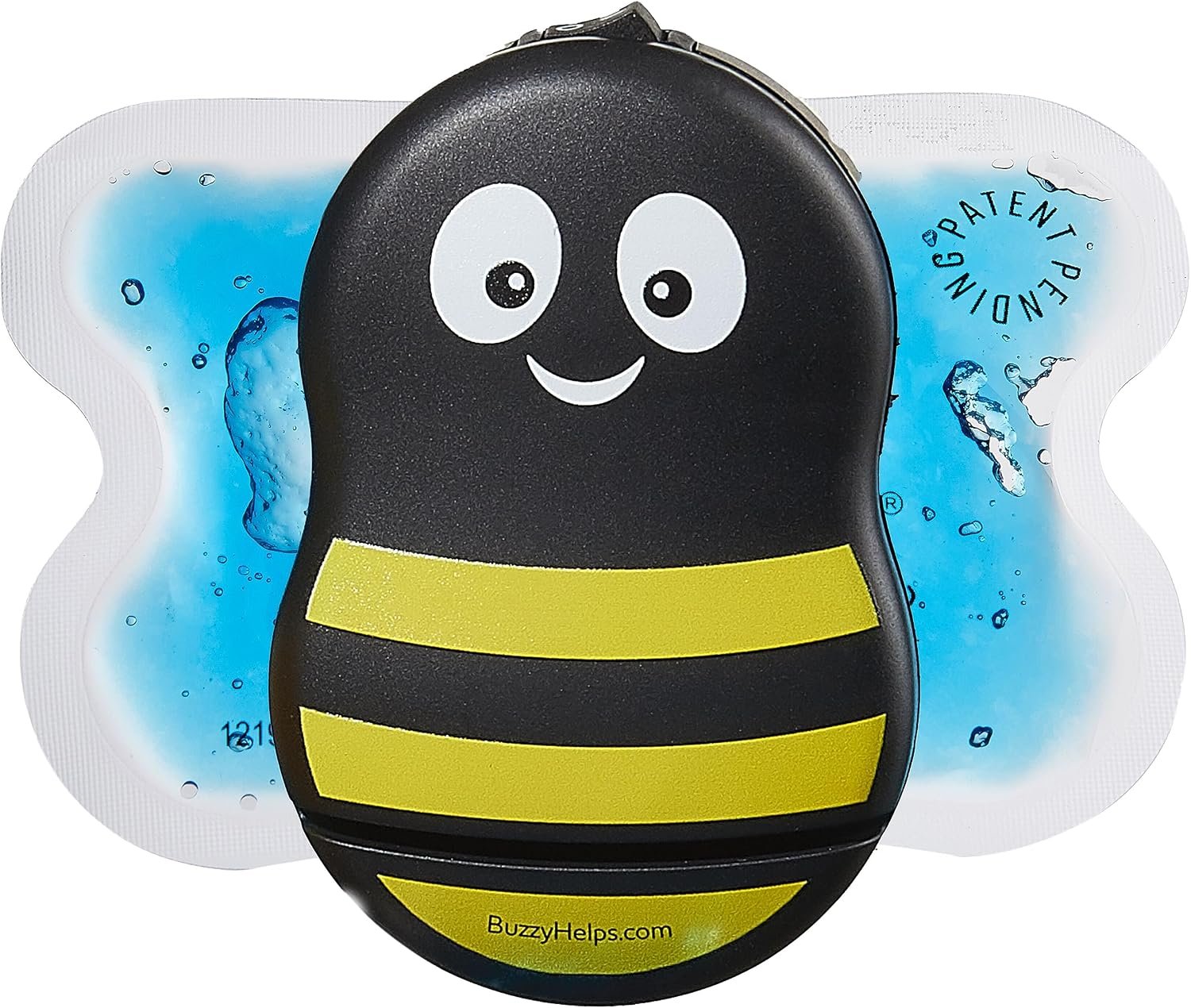
The Buzzy device is a personal injection comfort aid designed to combine cold with vibration. These physical sensations are intended to provide a competing sensory input around the area where an injection is administered.
The product is associated with the Buzzy brand and is marketed for needle-related situations, including vaccines and IVF injections. The striped version refers to the product’s appearance rather than necessarily indicating a different method of operation.
Unlike a topical anesthetic cream, which uses a medication to temporarily reduce sensation in the skin, a cold-and-vibration device works through physical stimulation. It does not rely on an anesthetic drug, although this does not mean that it is suitable for every person or every injection procedure.
The device should be understood as an additional comfort measure rather than a substitute for appropriate injection technique, prescribed medication instructions, or professional healthcare guidance.
Before using any particular version, it is important to check the current product listing and accompanying instructions for its exact components, dimensions, operating method, recommended placement, cleaning requirements, and intended applications. Product versions and included accessories can vary, so those details should not be assumed from the product name alone.
Key Features of the Buzzy Injection Pain Relief Device
1. Cold-Based Sensory Comfort
Cold is commonly used in some comfort strategies because cooling the skin can temporarily change local sensation. When applied appropriately, a cold element may make the skin feel less sensitive to certain stimuli.
In an injection setting, this can be useful because the sensation of a needle entering the skin is influenced by several factors, including the area being injected, the person’s sensitivity, and the technique used.
The Buzzy approach incorporates cold as part of a combined sensory method. The goal is to provide a cooling sensation around the injection area rather than to treat the underlying medical condition.
Cold exposure requires care. Excessive or prolonged cooling can cause skin irritation or cold injury, particularly in people with reduced sensation or circulation. Users should follow the manufacturer’s instructions regarding preparation, placement, duration, and skin contact.
A cooling device should not be assumed to work like a prescribed topical anesthetic, and it should not be used for longer than directed in an attempt to increase its effect.
2. Vibration as a Sensory Distraction
Vibration provides another type of physical sensation that may influence how a person experiences discomfort. The nervous system processes different sensory signals at the same time, and competing sensations can sometimes change the perception of a painful stimulus.
The Buzzy device combines vibration with cooling to offer a physical approach to injection comfort. This may be particularly relevant for people who find the anticipation of a needle stressful or who prefer a non-drug option.
However, sensory distraction does not guarantee that an injection will be painless. Responses vary from one person to another, and the result may differ depending on the injection site, the medication, the procedure, and individual sensitivity.
It is also worth distinguishing distraction from anesthesia. Vibration does not make the injection site completely insensitive, and the device should not be treated as a replacement for other pain-management methods when those are medically appropriate.
3. A Non-Medication-Based Approach
One practical distinction between a cold-and-vibration device and a numbing cream is that the device uses physical sensations rather than a topical anesthetic medication.
Some people prefer to limit the number of products applied to their skin, while others may have a medical reason to discuss medication choices with a healthcare professional. A physical comfort aid can offer another option to consider.
Nevertheless, non-medication-based does not mean risk-free. Skin sensitivity, cold intolerance, circulation problems, sensory impairment, and the requirements of a particular procedure may affect whether cooling is appropriate.
People who have medical conditions affecting sensation or circulation should seek professional guidance before using a cold-based device. The same applies when the intended injection site has irritated, damaged, or otherwise unsuitable skin.
4. Potential Applications Across Different Injection Settings
The product is marketed for several situations involving needles, including vaccinations, IVF-related injections, and other injection procedures.
These settings have different requirements. A vaccination may be administered by a healthcare professional in a clinic, while some fertility medications are injected at home according to a prescribed treatment plan. Other medications may have specific preparation, placement, or administration requirements.
A comfort device that is appropriate for one setting may not automatically be suitable for another. The product’s current instructions should be checked for compatibility with the specific injection procedure.
For instance, the timing and placement of a comfort aid may differ depending on whether the injection is given into muscle or subcutaneous tissue. The person administering the medication should retain full access to the correct injection site and follow the medication’s instructions.
5. A Physical Aid That Can Complement Other Comfort Strategies
Injection comfort often involves more than one approach. Depending on the situation, useful strategies may include calm communication, comfortable positioning, slow breathing, distraction, and appropriate clinical technique.
A cold-and-vibration device can potentially be incorporated into this broader approach when its use is appropriate. For a child receiving a vaccination, a caregiver might combine an approved comfort aid with reassurance and age-appropriate distraction. An adult receiving regular injections might incorporate the device into a consistent preparation routine if the healthcare professional approves its use.
No single strategy works equally well for everyone. Combining suitable approaches may be more helpful than relying on a device alone.
How Does Cold and Vibration Help With Injection Discomfort?
To understand the purpose of the Buzzy injection pain relief device, it helps to consider how the body processes sensory information.
Pain is a complex experience involving signals from the body, the nervous system, attention, expectations, and emotional responses. The same procedure can feel different to different people, even when the medical technique is similar.
The Role of Competing Sensory Signals
The skin contains sensory receptors that respond to different types of stimulation, including pressure, movement, temperature, and potentially harmful stimuli. The nervous system processes information from these receptors through interconnected pathways.
The gate-control theory of pain, introduced by researchers Ronald Melzack and Patrick Wall, helped explain how sensory input can influence the transmission and perception of pain signals. Although modern pain science is more complex than a single theory, the broader concept remains relevant: pain perception is not simply a direct measurement of tissue injury.
Touch, pressure, vibration, and other sensations can sometimes modify how discomfort is perceived. This helps explain why rubbing an area after a minor bump may provide temporary comfort.
A cold-and-vibration device applies this general principle in an injection setting. It supplies additional sensory input near the injection area, potentially changing the person’s experience of the procedure.
The degree of benefit is not guaranteed. The effect may depend on the person, the procedure, the placement of the device, and the way it is used.
Why Cooling May Matter
Cooling can temporarily alter the sensitivity of the skin. In some circumstances, this may reduce the intensity of certain superficial sensations.
However, the effect of cooling depends on temperature, contact time, skin condition, and the type of stimulus. Excessive cooling can be harmful, so it is important to follow the manufacturer’s instructions rather than improvising a longer or more intense application.
Cooling should also not interfere with medication storage, preparation, or injection requirements. Medicines that require particular temperature conditions must continue to be handled according to their own instructions.
The Influence of Anxiety and Anticipation
For some people, the anticipation of an injection contributes substantially to the overall experience. Seeing a needle, remembering a previous uncomfortable procedure, or worrying about an upcoming injection can increase tension before the procedure begins.
A predictable comfort routine may help some individuals feel more prepared. This could include understanding the steps, choosing a comfortable position, focusing on slow breathing, and using an approved sensory aid.
For children, clear explanations suited to their age and a calm caregiver can be particularly useful. For adults receiving frequent injections, a routine can make the process feel more structured and less uncertain.
A device should not be presented as a guaranteed solution to needle anxiety. People with significant needle-related fear may benefit from discussing additional support with a healthcare professional.
How the Buzzy Device Can Be Used
The correct way to use the Buzzy injection pain relief device depends on the specific model and the procedure involved. The manufacturer’s instructions should always take priority over general information.
The following examples describe potential settings in which an injection comfort device may be considered. They are not a substitute for the product’s directions or professional medical advice.
During Vaccinations
Vaccinations are among the common situations in which people seek ways to make injections more comfortable. Children may become distressed by unfamiliar surroundings, while adults may experience discomfort or anxiety even when they understand the importance of immunization.
A cold-and-vibration device may be considered as one element of a vaccination comfort plan if it is permitted by the healthcare professional administering the vaccine.
Practical considerations include:
- Confirming that the specific device is appropriate for the planned vaccination.
- Following the manufacturer’s directions for preparation and placement.
- Ensuring that the clinician can clearly access the correct injection site.
- Avoiding pressure or positioning that interferes with safe administration.
- Combining the device, when appropriate, with reassurance and distraction.
- Checking the skin after use and stopping if an unexpected reaction occurs.
The healthcare professional should determine the injection site and technique. The comfort device must never dictate where a vaccine is administered.
A parent or caregiver should also avoid promising a child that the injection will not hurt. A more realistic explanation is that the device may help make the experience more manageable, while acknowledging that some discomfort may still occur.
During IVF and Fertility Treatment
In vitro fertilization and related fertility treatments may involve medications administered by injection. Depending on the treatment protocol, some patients may need to give themselves injections at home over a series of days.
Repeated injections can create a practical and emotional burden. Even when each injection takes only a short time, the repeated preparation and anticipation can become stressful.
A device marketed for IVF injections may be worth discussing with the fertility clinic as a possible comfort aid. The clinic can advise whether the specific device is suitable for the prescribed medication, injection route, and injection location.
Important considerations include:
- Follow the treatment protocol. The device must not change the prescribed medication, dose, schedule, or injection technique.
- Confirm the appropriate injection location. Fertility medications can have different administration requirements, and placement should follow the clinic’s instructions.
- Protect medication handling. The cooling component must not compromise the medication’s storage conditions or come into contact with medication containers in an inappropriate way.
- Maintain hygiene. Follow the manufacturer’s cleaning instructions and keep the injection site prepared according to the clinic’s guidance.
- Avoid excessive cooling. More cooling does not necessarily provide greater comfort and can irritate or injure the skin.
- Ask for practical training. If a clinic has not encountered the device before, ask the care team to review its instructions before incorporating it into the routine.
A fertility clinic can also suggest other approaches if injections remain uncomfortable, including reviewing the prescribed technique or discussing whether a different approved comfort method is appropriate.
The goal is to make the routine more manageable without compromising the treatment plan.
For Other Prescribed Injections
Some people receive regular injections for ongoing medical conditions, while others need injections only occasionally. The appropriate approach to discomfort depends on the medication, the injection route, and the individual’s medical circumstances.
Before using the Buzzy device for a medication other than the situations specifically described in its current instructions, check with the prescribing clinician or pharmacist.
This is particularly important when the injection has strict placement requirements, the skin is already irritated, or the patient has a condition that affects sensation or circulation.
The device should never be used to justify changing the injection location, altering the angle of administration, or delaying a prescribed dose.
Preparing the Device and Injection Area
Before each use, review the instructions for the exact model. Confirm how the cooling element is prepared, how the vibration function is activated, where the device should be positioned, and how long it may remain in contact with the skin.
Inspect the intended area for redness, broken skin, swelling, or irritation. If the skin appears unsuitable, ask a healthcare professional whether another location or comfort strategy should be used.
Keep the injection equipment separate from surfaces or components that have not been cleaned according to the relevant instructions. Never allow a reusable comfort device to interfere with sterile needles, syringes, medication containers, or the prepared injection site.
After use, clean and store the device as directed. If the product contains removable components, do not assume that every part can be washed or immersed in water. Check the manufacturer’s guidance before cleaning it.
Who May Find This Type of Device Suitable?
The Buzzy injection pain relief device may be worth considering for several groups, provided the specific product instructions and relevant medical guidance support its use.
People Receiving Regular Injections
Individuals who administer prescribed medication regularly may appreciate having a consistent comfort routine. A non-medication-based device could be one option to discuss with a clinician when repeated injections create discomfort or anxiety.
The value of the device will depend on personal response and whether it can be used safely with the prescribed injection method.
Patients Undergoing IVF
People receiving fertility treatment may encounter repeated injections during a demanding period. A device specifically marketed for IVF-related injections may be relevant to this setting.
However, fertility protocols vary. Patients should confirm suitability with their fertility team rather than assuming that a product marketed for IVF is compatible with every fertility medication or injection site.
Children Receiving Vaccinations
Parents and caregivers may look for practical ways to make vaccination appointments less stressful. A sensory comfort aid may be one part of an age-appropriate plan, alongside reassurance, distraction, comfortable positioning, and guidance from the vaccination provider.
For children, adult supervision is essential. The device should be used only as directed, and the child should not be allowed to handle needles or injection equipment.
Adults With Needle-Related Anxiety
Some adults experience tension before injections even when they understand the medical purpose of the procedure. A structured routine involving breathing, distraction, and an approved physical comfort aid may help some people feel more prepared.
People who experience severe anxiety, fainting, or avoidance of necessary medical care should discuss this with a healthcare professional. Additional approaches may be appropriate, and a comfort device alone may not address the underlying difficulty.
Caregivers Supporting Another Person
Caregivers who help with prescribed injections may find it useful to understand different comfort options. The important consideration is that the device should support the person’s comfort without replacing appropriate clinical instructions.
Caregivers should explain what they are doing, obtain cooperation where appropriate, and avoid using the device in a way that causes distress or restricts necessary movement.
Important Things to Consider Before Using the Device
A product designed for injection comfort still requires careful use. Reviewing the following factors can help determine whether it is appropriate for a particular situation.
1. Check the Exact Model and Included Components
Product names and descriptions can refer to particular versions, colors, accessories, or package configurations. The striped version should not be assumed to include every accessory shown in promotional material or to have identical specifications to every other Buzzy model.
Review the current Amazon listing and manufacturer’s instructions for the exact item. Pay attention to the included components, operating requirements, cleaning guidance, and intended use.
If a feature is important to the intended application, verify it rather than relying on a general description of the product family.
2. Understand That Results May Vary
Cold and vibration may influence injection discomfort, but neither can guarantee a pain-free procedure. Some users may find the sensation helpful, while others may notice little difference.
The amount of discomfort can depend on factors such as:
- The injection site and route.
- The medication being administered.
- The individual’s sensitivity.
- The injection technique.
- Anxiety and previous experiences.
- The correct positioning and use of the device.
The product should therefore be considered a potential comfort aid, not a guaranteed pain-control solution.
3. Follow Cold-Exposure Precautions
Cooling can be uncomfortable or harmful if it is too intense or prolonged. Follow the exact directions for preparing and applying the device.
Do not improvise by adding unapproved cooling materials or extending the recommended contact time. Avoid using the device on areas where sensation or circulation is impaired unless a qualified healthcare professional confirms that it is appropriate.
Stop using it if the skin becomes unusually painful, excessively pale, numb beyond what the instructions describe, or otherwise irritated. Seek medical advice if a concerning reaction persists.
4. Consider Skin Sensitivity and Medical Conditions
People with cold sensitivity, circulation disorders, reduced skin sensation, or conditions affecting their ability to recognize discomfort may need additional precautions.
The same applies to people with damaged skin, active irritation, or an unusual reaction to cold.
Because a person may not reliably feel when cooling becomes excessive, professional advice is especially important when sensation is reduced. A device that is comfortable for one person may not be suitable for another.
5. Preserve Proper Injection Technique
The comfort device must never interfere with the injection itself. It should not obscure the site in a way that prevents the healthcare professional from identifying the correct location, and it must not change the prescribed method of administration.
For self-injections, follow the training provided by the prescribing clinician. If the device makes it harder to see or reach the intended area, stop and ask for guidance.
Do not modify the prescribed injection route, needle, medication dose, or timing to accommodate the comfort aid.
6. Maintain Appropriate Hygiene
Reusable devices require cleaning and storage according to their instructions. This is particularly important when a device is used in clinical settings, around children, or during repeated home injections.
Do not share a device without following the manufacturer’s cleaning guidance and the healthcare provider’s recommendations. If the device has removable components, verify which parts can be cleaned and how they should be handled.
Needles, syringes, and other injection supplies must remain separate from surfaces or components that could compromise their cleanliness.
7. Do Not Replace Necessary Medical Advice
The device does not treat the condition for which an injection is prescribed. It also does not replace professional assessment of persistent pain, swelling, redness, or other symptoms following an injection.
If an injection is unusually painful, the medication causes a concerning reaction, or the injection site develops symptoms that worsen or persist, contact an appropriate healthcare professional.
Seek urgent care for severe or rapidly developing symptoms, particularly signs of a serious allergic reaction such as difficulty breathing or swelling of the tongue or throat.
8. Consider the Practical Setup
Before choosing an injection comfort device, think about where it will be used and who will operate it.
For home use, consider whether the device is straightforward to prepare, store, and clean. For clinic use, ask whether the healthcare provider is comfortable incorporating it into the procedure.
For travel, review the manufacturer’s storage recommendations and any restrictions that apply to the product’s components. Do not assume that the device can be stored in every environment or that its cooling element can be prepared in any way.
Comparing Injection Pain-Management Categories
There are several general approaches to injection comfort. They serve different purposes, and the most suitable choice depends on the procedure, personal preferences, and professional guidance.
Cold-and-Vibration Devices
A cold-and-vibration device combines two physical sensations near the injection area. Its main distinction is that it uses sensory input rather than relying on a topical anesthetic medication.
This approach may appeal to people who want a reusable physical comfort aid, provided the product’s instructions support the intended application.
Potential limitations include the need for correct placement, adherence to cooling precautions, and individual variation in effectiveness. It may also be unsuitable for people who need to avoid cold exposure.
Topical Numbing Creams
Topical anesthetic products use medication to temporarily reduce sensation in a specified area of skin. Depending on the product and procedure, they may require advance application and a particular amount of time to work.
Their suitability depends on the medication, the person’s age and medical history, the injection site, and the instructions provided by a healthcare professional.
A topical anesthetic should not be substituted for a cold-and-vibration device, or combined with one, without checking whether the combination is appropriate. Using more than one comfort method does not automatically produce better results.
Cooling Products Without Vibration
Some comfort approaches rely primarily on cooling. They may offer a simpler physical method, but the effect depends on the cooling product and how it is used.
A dedicated cold-and-vibration device differs by adding vibration as a second sensory input. Whether that combination is more helpful for a particular person cannot be assumed without considering the procedure and individual response.
Any cooling product should be used according to its instructions to reduce the risk of skin injury.
Behavioral and Psychological Strategies
Breathing exercises, distraction, supportive communication, and comfortable positioning can help some people manage the emotional and sensory aspects of injections.
These methods do not require a physical device, and they can often be adapted to the person’s age and preferences. For children, this might involve a simple conversation or a distraction activity. Adults may prefer controlled breathing, listening to music, or focusing attention elsewhere.
Behavioral strategies can also be used alongside an approved physical comfort aid. The most appropriate combination depends on the individual and the clinical setting.
Professional Injection Technique
Correct injection technique remains essential regardless of the comfort product selected. Healthcare professionals are trained to choose the appropriate injection site, route, equipment, and procedure.
A comfort device should support this process rather than interfere with it. When pain is persistent or unexpectedly intense, reviewing the injection technique with a clinician may be more useful than simply adding another product.
These categories are not direct substitutes in every situation. A healthcare professional can help determine whether a physical device, topical anesthetic, behavioral method, or another approach is suitable.
Frequently Asked Questions
What is the Buzzy Injection Pain Relief Device designed to do?
The Buzzy device is designed to provide a combination of cold and vibration as a physical approach to managing discomfort associated with injections and other needle-related procedures. It is intended to serve as a comfort aid rather than replace medical care or guarantee a painless injection.
Can the Buzzy device be used for IVF injections?
The product is marketed for IVF-related injections, but suitability depends on the exact model, the prescribed medication, and the injection method. Patients should review the manufacturer’s instructions and confirm with their fertility clinic that the device is appropriate for their treatment protocol.
Is the device intended for vaccinations?
The product is marketed for use in vaccination settings. Before using it during a vaccination, confirm that the healthcare professional administering the vaccine approves its use and that it does not interfere with the correct injection site or technique.
Does cold and vibration completely eliminate injection pain?
No. The combination may influence how some people perceive discomfort, but it cannot guarantee that an injection will be painless. The outcome depends on individual sensitivity, the procedure, correct use, and other factors.
Does the device use medication?
The approach associated with Buzzy relies on physical sensations, specifically cold and vibration, rather than a topical anesthetic drug. Users should still check the exact product specifications and instructions for their model.
Can children use the Buzzy injection pain relief device?
The product is marketed for situations that include vaccinations, but the appropriate age range and conditions of use should be verified in the current instructions. Adult supervision is important, and the healthcare professional should confirm that the device is appropriate for the child and the planned procedure.
Is it suitable for every type of injection?
Not necessarily. Injection routes, sites, and medication instructions vary. A device that may be suitable for one injection should not automatically be assumed appropriate for another. Consult the prescribing clinician or administering healthcare professional when compatibility is uncertain.
How long should the device remain on the skin?
The appropriate duration depends on the specific model and its instructions. Follow the manufacturer’s guidance and do not extend the application time in an attempt to increase the effect. Excessive cooling can injure the skin.
Can the device be used with numbing cream?
Do not assume that combining a cold-and-vibration device with a topical anesthetic is appropriate. Check the instructions for both products and consult a healthcare professional, particularly when treating children or using the products near sensitive areas.
How should the device be cleaned?
Use the cleaning and storage method specified by the manufacturer. Do not assume that all components can be immersed in water or cleaned with the same products. If the instructions are unclear, contact the manufacturer before using an unapproved cleaning method.
What should someone do if the injection still hurts?
Some discomfort may remain even when a comfort aid is used. Follow the prescribed injection technique and ask the healthcare professional for guidance if the pain is unexpectedly severe, repeatedly problematic, or associated with concerning symptoms. Do not change the medication dose or injection method independently.
Can the device replace professional pain-management advice?
No. It is a complementary comfort aid. A clinician can assess the source of discomfort, determine whether another approach is appropriate, and provide instructions that account for the medication and the individual’s health needs.
Conclusion
The Buzzy Injection Pain Relief Device for IVF, vaccines, and injections offers a physical approach to injection comfort by combining cold and vibration. Its intended purpose is to provide additional sensory input that may help some people manage the discomfort or anticipation associated with needle procedures.
Its potential relevance extends to several settings, including vaccination appointments, fertility treatment, and certain prescribed injections. For people who receive injections repeatedly, having an additional comfort option may be worth discussing with a healthcare professional.
At the same time, expectations should remain realistic. The device cannot guarantee a pain-free experience, and its suitability depends on the exact model, the injection procedure, skin sensitivity, and individual medical circumstances. Correct injection technique, appropriate hygiene, safe cooling practices, and adherence to medication instructions remain essential.
Before using the striped Buzzy model, review the current product listing and manufacturer’s instructions to confirm the included components, operating method, cleaning requirements, and intended applications. If the device will be used during IVF treatment, for a child, or with a medication that has specific administration requirements, seek confirmation from the relevant healthcare professional.
For additional information about the product’s specifications and included components,
you can check more details on Amazon here:
As an Amazon Associate, we earn from qualifying purchases.
Leave a Reply